
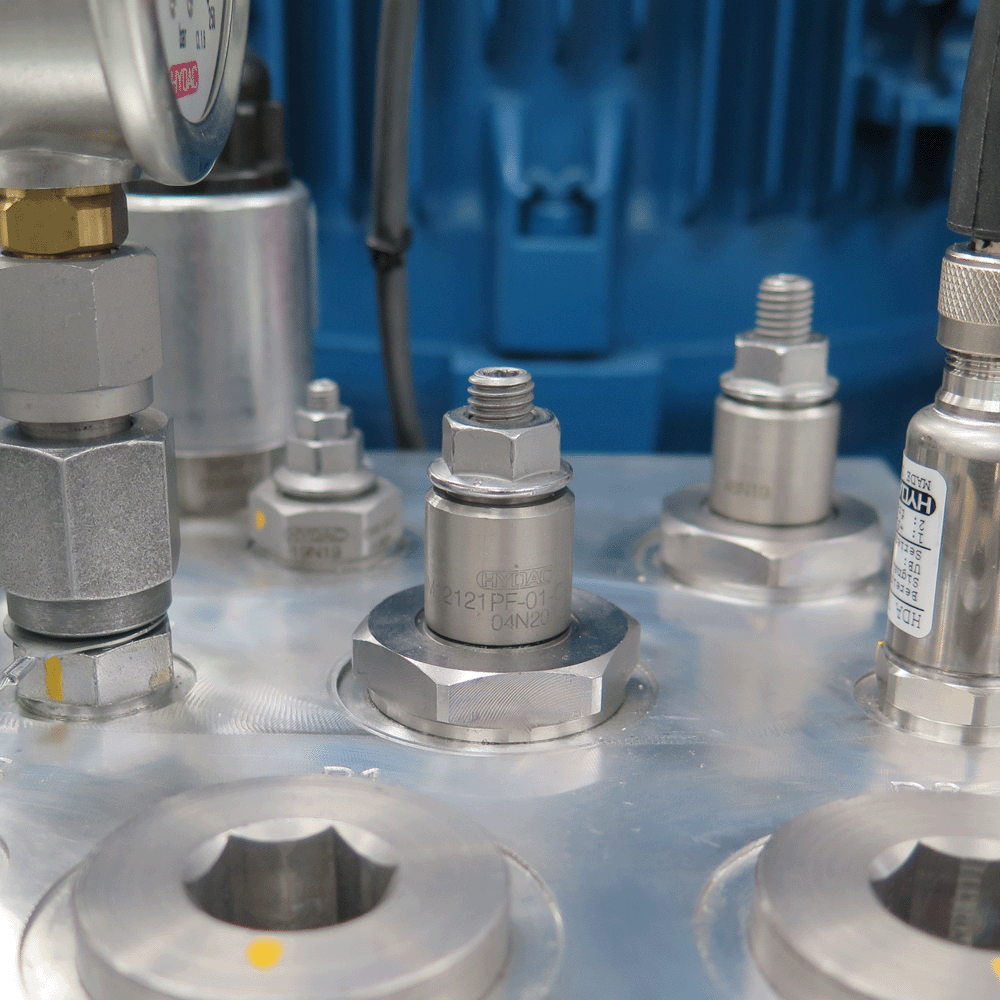
The pressure relief valve is one of the most important types of safety valves as it is designed to alleviate or control overpressure levels for prime functionality in any system.
The pressure relief valve limits system pressure by diverting excess flow to tank.

The schematic shows the pressure relief valve highlighted in grey and the pump (circle on left-hand side) delivering into the system.
The system cannot accept flow if it has a closed port (between P and T in schematic). The consequence is that all flow is in excess of that which is required.
This means that if required the valve sends all flow to the tank.
Therefore, the system is limited by not letting it build up excessively. And, in fact, no more pressure than the setting of the valve is visible.
The valve then becomes significant when it comes to understanding a hydraulic system because the relief valve setting must be overcome to get fluid to the tank.
Consequently, there is pressure on the gauge (circle with arrow in the schematic). This creates hydraulic pressure, which can then be applied to an area in the actuator, the cylinder.
Pressure can be applied to that area to create a force that pushes the cylinder out.
Alternatively, if the direction of flow is changed to the other side of the cylinder, the cylinder is pushed right back in.
The capacity to do so comes with the force required for the machine to work. This constitutes a pressure relief valve in operation.
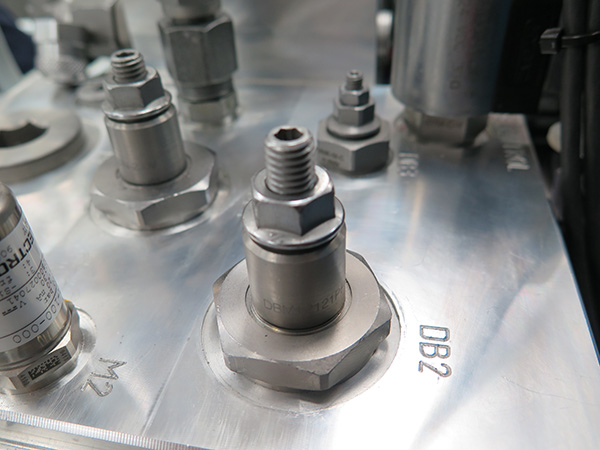
Pressure Relief Valves - Adjustment options
There are a few options for pressure relief valves in physical design.
Adjustment options include:
- Fixed
- Allen key
- Domed nut
- Hex
- Scaled knob
The most common adjustment option is the Allen key tool to adjust with a nut and spanner.
The other option is a domed nut where a lead seal can be used that shows up as a tamper-proof seal or a more decorative one.
The hex – an uncommon option – is where pressure can be adjusted with the same spanner that unlocks the nut, making for adjustment with a single tool.
As to the scaled knob, all pressure relief valves on HYDAC’s training rigs have this type of knob due to the constant adjustment that needs to take place.
The last option is fixed, which signifies a tamper-proof and tamper-evident setting on the valve.
This is ideal for scenarios where it’s critical that the pressure relief valve, as a safety device, works, with no threat of setting adjustment.
An example could be a case where a critical asset is being protected.
In this case the valve is ordered with the setting required for simple pre-set with a spring that is packed to a certain tension and therefore a certain pressure.
For further information, call HYDAC Australia on 1300449322 or email info@hydac.com.au.
Contact us for more information


